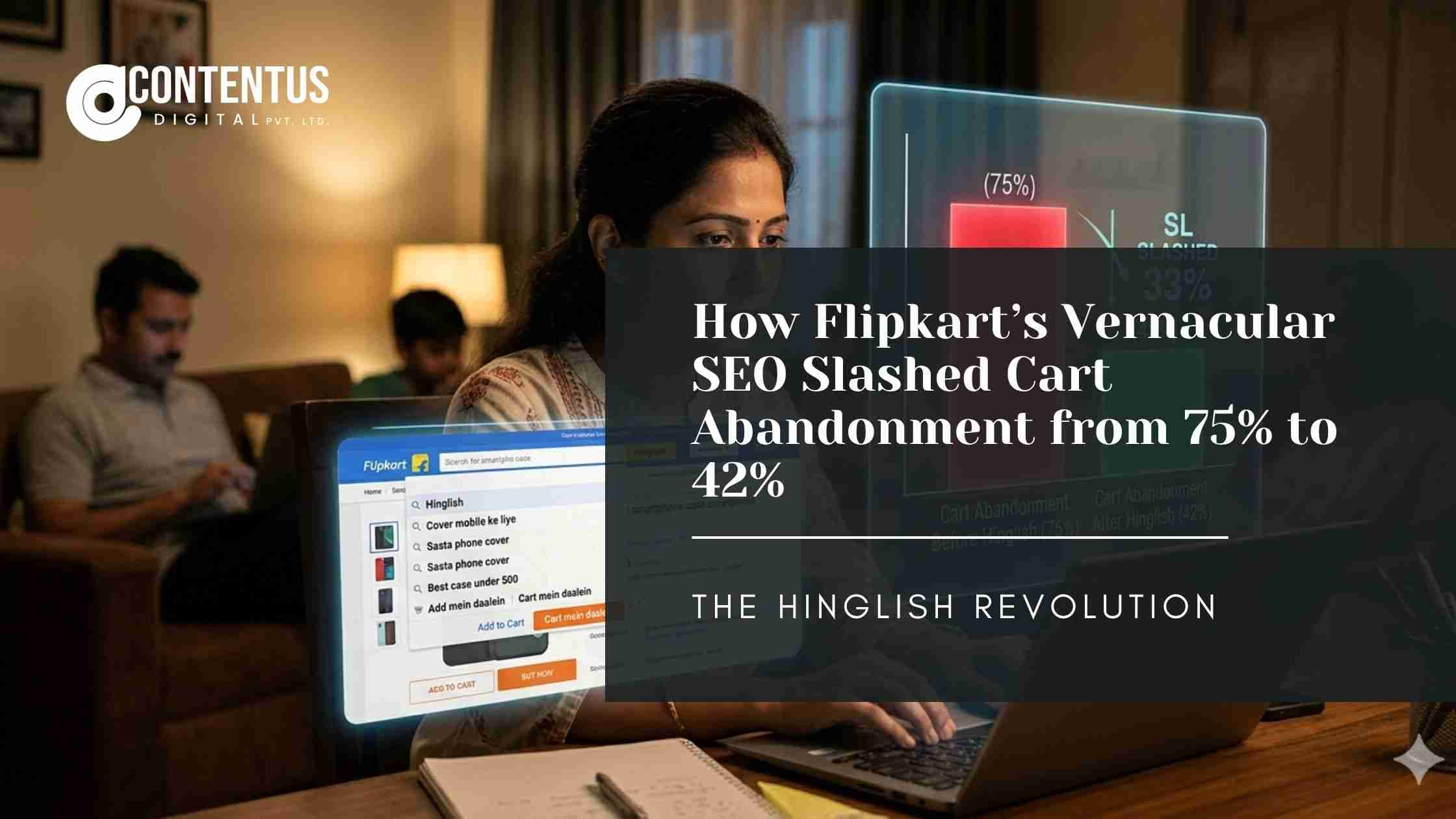
The Hinglish Revolution : How Flipkart’s Vernacular SEO Slashed Cart Abandonment from 75% to 42%
In this competitive Indian e-commerce arena, the battle for the “Next 200 Million” users won’t be won just by offering the deepest discounts. You must think beyond the discounts. Here, Flipkart’s Hinglish SEO strategy has become a game changer. It’s all about who speaks the consumer’s language most authentically. For years, Flipkart, the homegrown titan of Indian retail, faced a staggering wall. That’s a 75% cart abandonment rate among shoppers from Tier-2 and Tier-3 cities. While these users were digitally savvy enough to browse, they were dropping off at the most critical juncture: the checkout. The culprit? The ‘Language barrier’ from an English-centric interface that caused hesitation and mistrust. Hence, by pivoting to a sophisticated Hinglish SEO and Vernacular Content Strategy, Flipkart didn’t just translate its website; it rebuilt the bridge of trust. This transition successfully reduced cart abandonment to 42%. It unlocks a massive demographic often referred to as “Bharat.”
The Anatomy of the 75% Abandonment RateTo understand the solution, we first must analyze the problem. Here is this-
For a shopper in a town like Gorakhpur or Erode, an e-commerce app in English feels like a school. So, terms like “CVC mismatch,” “Authentication failed,” or “Standard Shipping” carry an extra weight for them. As a result, they might experience difficulty understanding those terms. In such a scenario, when a user is asked to part with their hard-earned money, any ambiguity in language is perceived as a risk.
In Indian retail culture, window shopping is quite a normal social activity. On mobile apps, users often use the cart as a wishlist or a virtual dressing room. However, Flipkart found that while some abandonment was intentional, a huge portion was due to a language barrier. Specifically, it caused decision fatigue due to the cognitive load of translating English commerce terms into users’ local languages in real time.
Before optimizing Flipkart Hinglish SEO strategy , their SEO was built for global standards. For example, they were ranking for “Noise-cancelling headphones”. But their target audience was typing “Bahar ki awaaz rokne wala earphone” into Google. So, it had worked as a huge red flag for Filpart. This indicates that though users found the site, the landing page content didn’t speak their language. This language gap led to immediate bounces. So, it had worked as a huge red flag for Filpart. The ‘Bharat’ Strategy: Decoding the Hinglish EcosystemFlipkart’s “Bharat” framework was a multi-layered overhaul involving data science, linguistics, and technical SEO. This framework is a great example of Vernacular E-commerce India, showing how the use of regional language keyphrases is helpful for an e-commerce giant. The aim of designing the ‘Bharat’ model was to capture the next 200 million e-commerce users in India, specifically those residing in Tier-2 and Tier-3 cities, small towns, and rural areas. It’s about building a platform for the value-conscious, mobile-first shopper who prefers regional languages and “Hinglish” over formal English. A. Transliteration Over Literal TranslationWhen Flipkart’s engineering team started collaborating with AI researchers, they realized that literal translations were often more confusing than the original English. For example, translating “Cart” to the formal Hindi word “Vahan” or “Delivery” to “Vitaran” felt robotic and alienated the user. Thus, the team adopted Transliteration. What is that? It’s nothing but a practise of representing the text of one language in the writing system of another language. So, Flipkart wrote “Cart” as “कार्ट” and “Order” as “ऑर्डर”. This way, the ultimate Hinglish Solution arrived which was the beginning of Flipkart Hinglish SEO strategy. This mirrored the natural code-switching that Indians do: using English nouns within a Hindi sentence structure. B. The “Bharat” Keyword ModelSo, Flipkart’s SEO team stopped chasing high-volume English keywords and started mapping conversational intent. Also, they focused on two things:
C. Voice Search OptimizationAs voice search takes less time than typing, a significant portion of the ‘Next 200 Million’ users prefer speaking to their phones over typing. Thus, Flipkart optimized its metadata to capture long-tail, spoken queries. This required their SEO crawlers to understand regional accents and colloquialisms. So, by deploying an in-house NLP (Natural Language Processing) layer, they ensure that a voice search like “Sasta wala waterproof watch dikhao” leads directly to a filtered product page. How the Flipkart Hinglish SEO Strategy Reduced Abandonment?The impact of this linguistic shift was most visible in the Bottom of the Funnel (BoFu). It significantly helped to reduce cart abandonment India. Here are the quick scenarios of that. Lowering the “Checkout Friction”By introducing a Hinglish checkout flow, Flipkart addressed the “Final Click Anxiety,” which is the moment of fear right before you hit “Pay.” You wonder: Is my money safe? Did I pick the right address? Can I get back in if the payment fails? When the payment screen says “Payment safal rahi” (Payment was successful) instead of just “Transaction Complete,” it triggers a different emotional response. It feels like a confirmation from a trusted local shopkeeper. Trust Signals and Social ProofThen, Flipkart localized its review system. Seeing a review that says, “Product ek dum badiya hai, packing bhi mast thi” (The product is excellent, the packing was great) is infinitely more relatable to a vernacular user than a grammatically perfect English testimonial. This peer-to-peer trust is the ultimate antidote to decreasing cart abandonment.
Flipkart Hinglish SEO strategy Analysis: Keywords for the Bharat MarketTo replicate Flipkart’s success, you must target the high-intent and low-competition vernacular phrases in your niche. Here are some examples of Flipkart’s English and Hinglish keywords strategy. Primary Keywords (PK)
Long-Tail & Hinglish Keywords (LTK)
5. Technical Implementation: The Hinglish SEO ChecklistIf you are building a brand for the Indian market, follow this technical blueprint:
The Science of “Digital Comfort”: Why Vernacular UX Reduces the Pain of PayingTo understand why Flipkart’s Hinglish shift worked, we have to look at Cognitive Load Theory (CLT). In e-commerce, when users aren’t purchasing anything, every second they spend decoding a page.
When a non-native English speaker shops on an English site, their brain performs two tasks simultaneously:
As a result, users put more mental effort into translating the texts rather than the products. Hence, it creates a high extrinsic cognitive load. Research shows that when the brain is overwhelmed by the task of decoding a second language, it defaults to a state of decision paralysis. By using Hinglish, Flipkart effectively removed the ‘language tax ’ that allows the user’s brain to focus entirely on the purchase.
Neuroscience tells us that spending money activates the Insula, the brain region that processes physical pain and disgust. That indicates the brain holds you and raises a question in your mind about whether it is worth paying for the product/service.
This way, the familiar phonetics of a mother tongue or a comfortable hybrid like Hinglish act as a cognitive buffer. It triggers the release of dopamine by providing a sense of fluency, which masks the neural pain of spending money.
One of the core pillars of UX is that humans are better at recognizing than recalling.
Low-cost roadmap for small businesses to adapt the Vernacular SEO strategy1. The Google Business Profile (GBP) LocalizationFor a small business, your GBP is your most powerful tool. It’s where “Bharat” finds you first on Google Maps.
2. User-Generated “Hinglish” ReviewsRemember that Google’s 2026 algorithm prioritizes customer reviews in the language of the searcher.
3. Build “Problem-Solution” Landing PagesSmall enterprises often make the mistake of having just one “Services” page that describes all the services. But one page is not sufficient to win at vernacular SEO. Here, you need topic clusters that prove your E-E-A-T to search engines. For this, you must create multiple major services pages under the landing page named “Services”. Now each major services page should contain multiple sub-services pages. Moreover, you must create blog posts to build topical authority. The logic is the same for the blog posts, too. That means you have to choose one major topic and then write multiple blog posts related to the topic. Here is a simple strategy given for this purpose:
4. Optimize for “Transliterated” URLsMany SMEs use complex English URLs. For the Bharat user, simplicity is key. Here is how you can do it – For example, instead of xyzshop.com/heavy-duty-water-purifier-for-home you can use xyzshop.com/sasta-water-purifier. Why it works? Google’s NLP understands that “sasta” and “budget” are synonyms in the Indian context. Low-Cost Tool Stack for SMEs (2026)
As a small business owner, you have one advantage: authenticity. You actually know the local words of your neighborhood. By using these words in your digital presence, you can remove the intimidation factor that causes 75% of people to walk away from a cart. The Hinglish brand voice guide for e-commerce content marketers 20261. The Golden Rule: “Listen, Don’t Translate”The major mistake content marketers make is writing the phrases in English and then converting them into Hindi. But it’s not the right procedure. Hence, Flipkart uses Hinglish- both Hindi and English within a phrase. This way, they not only build customer trust but also write for the ear. So, take a litmus test. If you read the sentence out loud, does it sound like an urban Indian talking to a friend?
2. The “Noun-Verb” Transliteration FormulaFlipkart’s secret to reducing cognitive load was keeping technical nouns in English (transliterated) while using action verbs in Hindi.
3. Tone & Personality: “The Tech-Savvy Dost”Your brand voice should sound like a helpful neighbor who knows how to use an app. So, it should be empathetic, value-conscious, and direct.
4. SEO Content Writing: The “Hinglish Cluster” MethodTrain your writers to weave keywords into a hybrid sentence structure to capture Google’s 2026 NLP (Natural Language Processing). The Keyword: “Best budget smartphone under 10000.” The Hinglish Content Piece: “Kya aap dhoond rahe hain sabse sasta aur accha mobile? 2026 mein, best budget smartphone under 10000 choose karna thoda mushkil ho sakta hai. Par fikar na karein! Humne aapke liye ek list taiyar ki hai jo features aur price dono mein ek dum top hai.” 5. Visual Hierarchy & “Hinglish” Graphic DesignSEO isn’t just text; it’s how users retrieve information. Use texts that are easy to grab attention and empathetic, too.
The “Bharat” Content Audit ChecklistIf you’re following Flipkart Hinglish keyword strategy, give this to your editors before any blog or product page goes live:
Beyond the 42% Abandonment GoalBy adopting this guide, your enterprise isn’t just chasing Flipkart’s 42% metric; you are building topical authority in a language spoken by 500 million people. But only a few brands have mastered it. So, in 2026, the brand that speaks “Bharat” wins “Bharat.” Conclusion: Empathy as an SEO MetricFlipkart’s journey from 75% to 42% abandonment isn’t just a story of better algorithms; it’s a story of digital empathy. By acknowledging Vernacular E-commerce India’s strategy, Flipkart won clicks and the confidence of a nation. As we move further into 2026, the brands that thrive will be those that realize the internet is not a monolingual space; it’s now multilingual. FAQs |