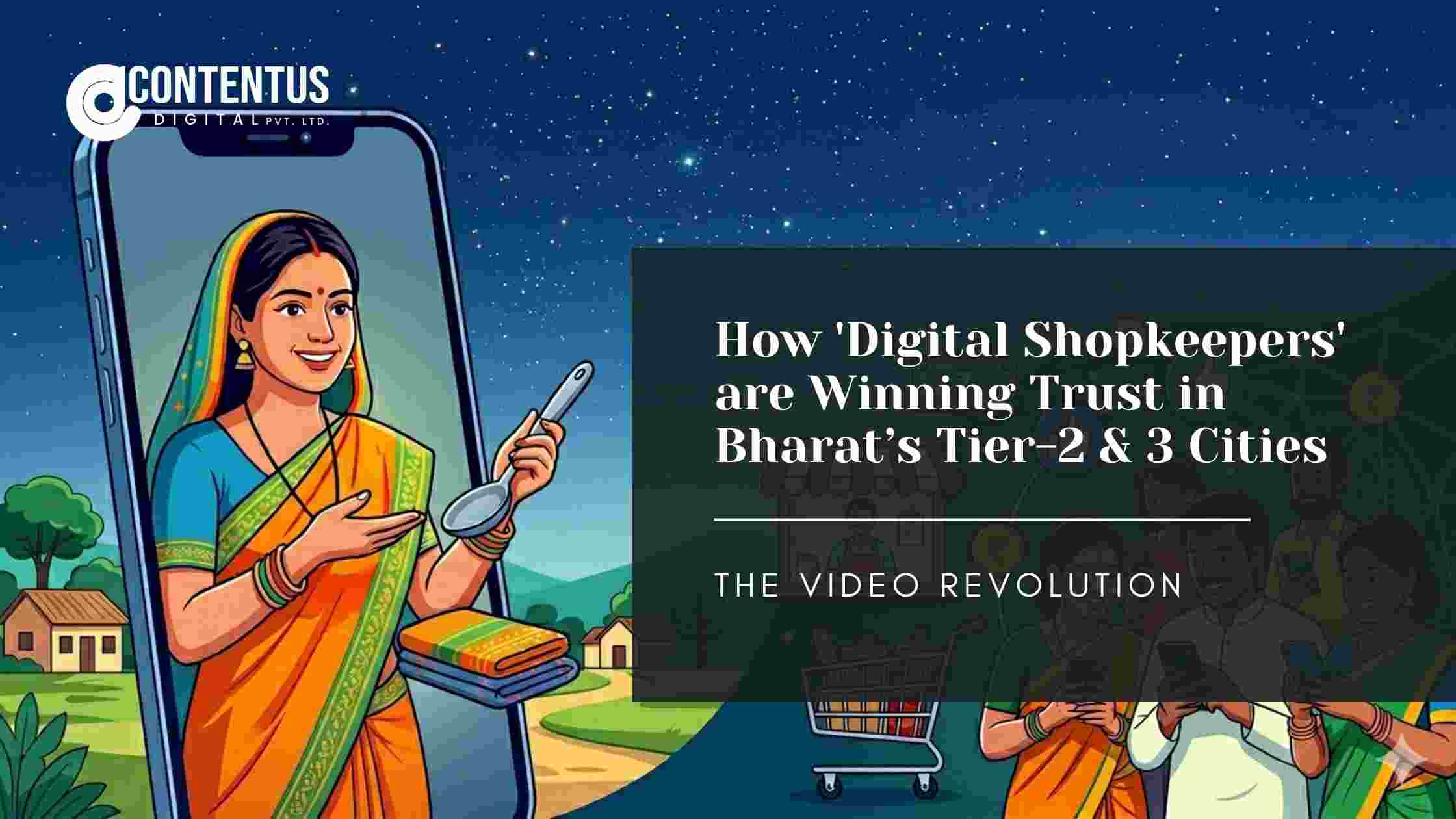
The Video Revolution: How ‘Digital Shopkeepers’ are Winning Trust in Bharat’s Tier-2 & 3 Cities
As India’s digital landscape expands, e-commerce brands are experiencing a new challenge. It’s nothing but the functional “dead end” of the traditional, image-and-text product page for the next 200 million users. But why “dead end”? While the technology to shop online exists, the psychological trust to complete the transaction is missing, especially in Tier-2 and Tier-3 cities. As these simple product pages can’t showcase the natural functionality of the products, people can’t trust these pages anymore. Here video commerce strategies for Tier-2 and Tier-3 cities acts as a game changer.
This is the central challenge of the “Bharat” market. For these users, the primary barrier isn’t the final price, it’s final click anxiety. It’s the silent, powerful doubt that asks: “Will this product look like the picture?””If it breaks, will anyone help me?”
To solve for this, content marketers and product managers are embracing a powerful new infrastructure: video commerce strategies for Tier-2 and Tier-3 cities.
Why a Static Product Page is a “Dead End”?
To understand why static pages fail in “Bharat,” you must first understand the neuroscience of trust.
In our previous blog, the section of case study on Hinglish SEO we have already discussed that , shopping online can trigger the brain’s Insula. This region is associated with physical pain and disgust. This “pain of paying” highly related for a user with lower digital literacy and higher socioeconomic vulnerability who rely on face-to-face transactions.
In a physical local shop, trust is built not through a product specification sheet, but through a human relationship. Also, to built a powerful online presence, the local shopkeeper becomes the digital shopkeeper who acts as a linguistic and quality-assurance provider. For example, they answer questions, they demonstrate how a mixer-grinder works, and they provide the ultimate form of social proof: their own personal guarantee.
However, previously a standard Amazon or Flipkart page (in English) completely removes this multilayer authentication. It demands that the user:
Can read and interpret complex specifications in a second language.
Trust a professional, studio-generated photograph.
Trust a written review from a stranger, potentially from a different cultural background.
For a new-to-internet user, this “ English Only” approach becomes a high-Frictional, low-trust environment. But here you can’t ask the user to change their behavior. Instead you must adapt the interface in such a way so that it matches the their existing social and cognitive habits. That means moving from “Product-First” static page to “Human-First” video.
They are not just new customers; they are a unique cultural segment with distinct shopping behaviors, rooted in the offline experience of a bustling local market.
Why Video & UGC Social Proof Works Here?
So, from the above description it’s clear that the shift from static to video is not just a trend; it’s become mandatory now. Actually, a video works as a data-backed conversion driver. Industry reports provide solid proofs about these. The reports reveal that Conversion rates of video-assisted shopping in India
can lead to 20–30% higher conversion rates compared to static pages, especially in regional markets.
But how does video work where images fail?
Lowering the “Cognitive Fluency” Barrier
You have already known that listening and watching are much more effective activities as compared to reading because these require active interpretation. Thus, when you create a video, it bypasses the brain’s high-energy language processing center. That’s why video increases Cognitive Fluency, making the process feel more “natural”, digestive, and less overwhelming
Activating the “Trust-Receptor” (Dopamine vs. Cortisol)
While text triggers analysis and potential doubt, video triggers emotional engagement. How? In a video, a warm, relatable person on-screen, speak in a familiar dialect. It can release dopamine and oxytocin, the “bonding” and “reward” hormones. This chemical shift directly counteracts the Cortisol (stress hormone) produced by translation and transaction anxiety.
Real-Time “Reality Testing”
For a skeptical user, a studio photo is “fake.” So, when they see a video, especially one that shows a product being unboxed, turned on, or worn, is viewed as “real.” It provides immediate sensory confirmation that the product exists and functions as assured by the seller.
This is where User Generated Content (UGC) becomes the content marketer’s ultimate tool. For a user in Tier-2, a YouTube channel of high-fashion influencer in South Mumbai is not relatable. Rather than they will prefer UGC written in their local language. For example, a mother from Varanasi unboxing a pressure cooker and speaking in her local dialect is looking for UGC written in heir native language.
This UGC in regional dialects for e-commerce trust acts as hyper-localized social proof. Thus the other users think, “If she uses it and trusts it, I can too.” This builds a “Trust Network” where language and dialect, not formal reviews, are the currency of reliability.

Case Study: Two Models of Building Video commerce strategies for Tier-2 and Tier-3 cities
Let’s compare Flipkart vs Meesho video commerce case study to analyze different video commerce models to bridge the trust gap.
Model 1: Flipkart’s Video-Assisted Shopping (The “Guided Tour”)
Pioneering Cash on Delivery, as a marketplace giant with a history of building trust, Flipkart’s approach is structured and educational. Their goal is to replicate the “Digital Shopkeeper” within the app itself.
The Model: Flipkart utilizes a structured, professional video approach for user guides and demonstrations. They host live shopping festivals like Big Billion Days with dedicated video streams, mentioning clear discount rates. Moreover, they have “Guided Buying” widgets where experts walk you through product specifications. For example, instead of traditional spec like “8GB LPDDR4X RAM”, guided buying explanation: “This means you can open 20 apps at once without the phone slowing down” is adopted for this model.
How it Builds Trust: This model acts as a quality filter. When a “Flipkart Expert” (or a recognized, structured voice) demonstrates a product, it signals, “This product has been checked by us, the platform.” Specifically, it’s vital for high-ticket items like electronics, appliances, etc. It changes the perceived transaction from “Me vs. a nameless seller” to “Me and Flipkart confirming this purchase.” This way they are reducing cart abandonment through video-first UX.
Model 2: Meesho’s Influencer-Led Social Model (The “Friend-to-Friend” Trust)
Meesho’s growth is built almost entirely on social and influencer trust. Their roots are in social reselling, and their video model reflects this.
The Model: Meesho excels at decentralized, hyper-localized UGC. They don’t just use te expertise like Flipkart; they also use thousands of micro-influencers and everyday users (resellers) who speak in regional dialects (Bhojpuri, Tamil, Bengali). These creators make short, relatable videos on YouTube, Instagram, and within the Meesho app feed. The video topics include unboxing clothes, showing quality, and giving “personal” guarantees.
How it Builds Trust: This model creates a horizontal trust network. It doesn’t rely on the platform’s authority; it relies on social connection. For fashion, home goods, and other lifestyle products, a review from someone who looks and talks like you is more powerful than any platform guarantee. The message is simple: “My friend (or a friendly face in my city) bought this and liked it. I will too.”
Conclusion: The Future is (Regional) Video
Video commerce is not just an additive feature; it is the new commerce infrastructure for India’s Tier-2 and Tier-3 cities.
For these markets, Content is a revenue driver, not just a marketing channel.
So, how to build digital trust for Bharat users? To win, brands must shift from thinking about text (Search Intent) to video (Visual Trust). The winning formula isn’t a single, but a dual strategy:
Social Proof (Regional UGC): Indian e-commerce brands like Flipkart integrates video content from everyday users in diverse dialects directly onto the product page. It makes your “Add to Cart” button a calm, Dopamine-rich confirmation, and make your “Review” section a credible playlist of local dialects.
Platform Authority (Hinglish): They continue using Hinglish and transliteration for technical confirmation (e.g., कन्फर्म for Confirm), as it stabilizes the high-anxiety moments.