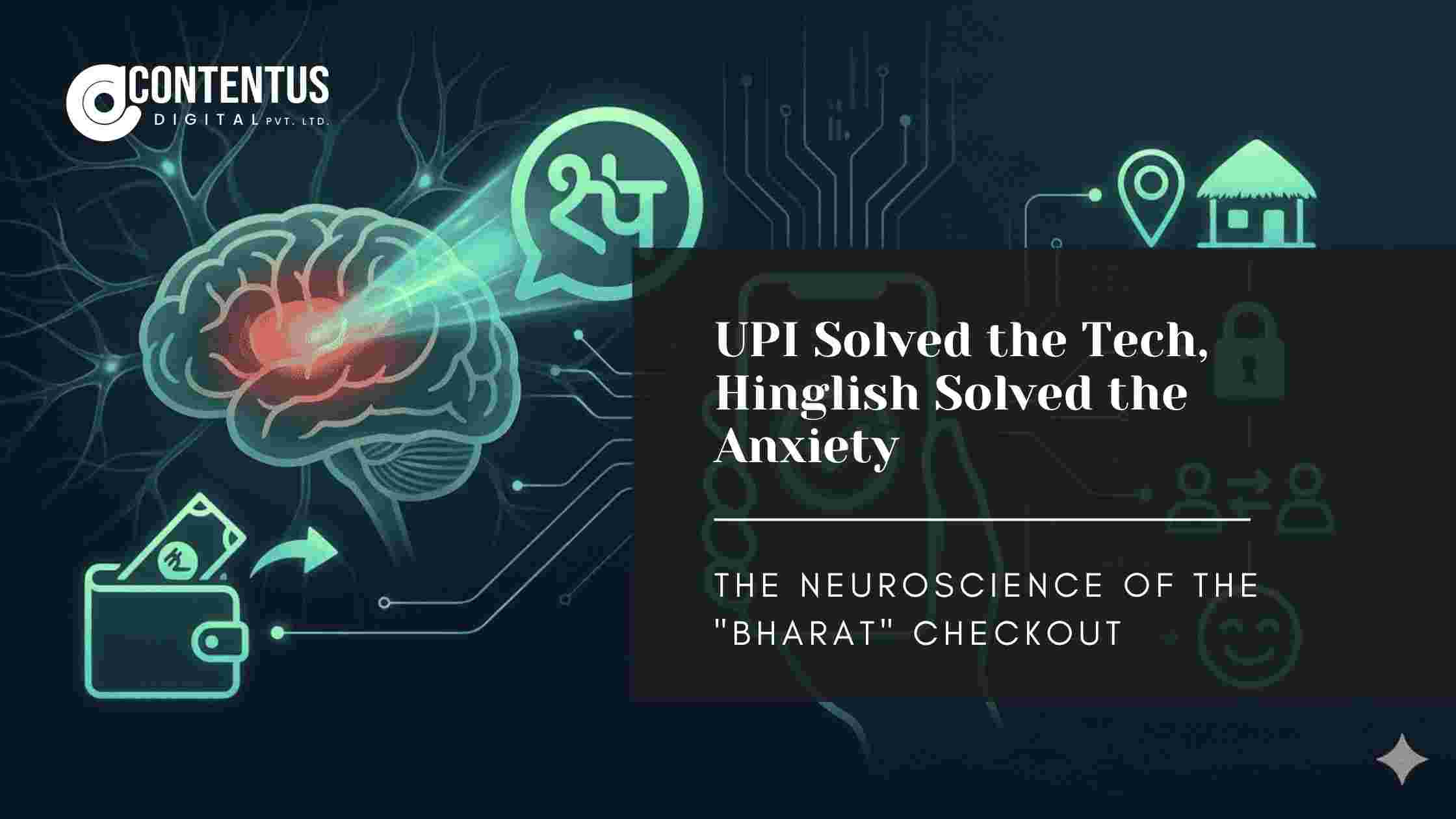
UPI Solved the Tech, Hinglish Solved the Anxiety: The Neuroscience of the “Bharat” Checkout
For the next 200 million e-commerce users in India, the journey from “Add to Cart” to “Order Placed” is a psychological minefield. In the corridors of Silicon Valley, “frictionless payments” is a buzzword for speed. But in the villages of India, friction is about biological stress. When they see a traditional English UX, it causes lack of confidence to them. But why? To learn this you must understand the neuroscience of digital payment anxiety in rural India.
While the Unified Payments Interface (UPI) built the digital rails, the lack of technical ability of the users from rural India results lack of emotional safety to do the payments. To bridge this gap, leaders like Flipkart turned to neuroscience, using phonetic transliteration in fintech UX to deactivate the brain’s “pain centers.”
The Insula: Why Spending “Hurts” (Literally)
The neuroscience of digital payment anxiety in rural India begins with a part of the brain called the Insula (Insular Cortex). This is the brain’s “alarm system,” associated with physical pain and disgust.
When a urban, tech-savvy user spends money, their “Reward Center” (Nucleus Accumbens) usually outweighs the Insula. However, for a rural shopper, seeing a formal, English-only payment screen triggers a “Threat Response.” To them, English is the language of banks, lawyers, and fine print. Hence, an English interface create an alarm in their brian. First of all, they are not accustomed with the technical jargons like ‘No Cost EMI’, ‘Flipkart Pay Later’, or ‘Payment Gateway’. Furthermore, English doesn’t create a sense of credibility within them as their local languages can. As a result, they feel insecure and fear of losing money.
UPI: The Rails Without the “Trust Layer”
In 2026, UPI processes over 19 billion transactions monthly and solved the infrastructure problem too. But it didn’t solve UPI payment friction vs. trust in Bharat yet.
In early rural e-commerce, checkout pages were filled with scary, formal terms:
“Authentication Required”
“Transaction Processing”
“Authorization Failed”
To a first-time user, these sound like digital errors or, worse, potential scams. Also, the invisible nature of digital money already feels less reliable than cash. Furthermore, adding a language barrier makes the transaction feel like a gamble.
Phonetic Transliteration: The Secret to Reducing Insula Activation
The breakthrough came when designers realized that they didn’t need to translate the checkout into pure Hindi. Rather than they needed to transliterate it. This is the core of reducing the panic due to Insula activation during checkout.
The “Neural Buffer” Table
Why “कन्फर्म” (Confirm) Wins in 2026:
It’s already familiar: People hear the word “Confirm” on TV, on the radio, and in daily conversations. As they recognize the sound instantly, they don’t have to stop and think about what it means. Formal words like “Pushti” are rarely used in daily life, so the brain takes longer to process them.
It feels like a normal conversation: Using “कन्फर्म” makes the app feel like it’s talking to the user in a natural way. When the screen uses language that feels friendly and normal, the user feels more relaxed. This calmness helps them feel safer, which makes it much easier for them to finish the payment.

Case Study: Flipkart’s “Neural UX” Overhaul
To understand why Hinglish SEO is a cognitive necessity, we must look at the hands-on data regarding digital adoption. For this case study, we have taken some vital information from a recent research of European Economic Letters (Vol. 15) on digital payment variance. The research states that the acceptance of digital payments in rural regions is not just an infrastructure problem, it is an “Attitude and Literacy” problem.
The Empirical Evidence: Identifying the Obstacles
The study explicitly finds that rural adoption faces four primary roadblocks:
Systemic Distrust: A fundamental skepticism toward digital platforms.
Fear of Fraud: Constant worry regarding transaction security.
Inadequate Mobile Literacy: A lack of confidence in navigating complex app interfaces.
Limited Information Availability: A gap in understanding how digital systems actually work.
Research Excerpt: “The improvement of socioeconomic status, educational levels, income, and information availability has resulted in a rise in the involvement of rural individuals in digital commerce.”
So, this research proves that for Flipkart to achieve the success, visibility is not enough. It’s about to be understandable for the audience.
The Flipkart Strategy: Solving for the “Vulnerable Rural Population”
Flipkart’s “Bharat” strategy was perfectly engineered to address the study’s finding that “people with higher education levels utilize digital payments more than the vulnerable rural population.” To close this gap, Flipkart treated Language as Infrastructure.
Step 1: Overcoming Distrust via Linguistic Familiarity
Flipkart recognized that the “Distrust” mentioned in the findings was often a byproduct of the “English-only” barrier. By introducing Phonetic Transliteration they transformed a “foreign” banking process into a local transaction. But what does it mean? Writing English terms in local scripts (e.g., “Confirm” as कन्फर्म). This directly reduced the Insula activation that the study from European Economic Letters categorizes as “worries about fraud.”
Step 2: Addressing Mobile Literacy with Hinglish Micro-Copy
The research notes that “Mobile devices and internet access greatly impact acceptance”. But they are only effective if the user knows how to use them. Thus, Flipkart simplified its UX writing to match the “Mobile Literacy” levels of Tier-3 cities. Instead of formal Hindi, they used “Hinglish.”
For example, the study mentions that “Financial literacy plays a vital role.” Flipkart improved this literacy not by teaching finance, but by using semantic mapping. But what does it mean by semantic mapping here? Semantic mapping connects complex, technical terms to words that users already knows from daily life.
So, instead of teaching a word like “Authentication” to the rural users, Flipkart maps that action to a familiar phrase like “Verify karein.” This replaces a confusing “English Wall” with a “Mental Bridge”. That means users can complete tasks using their existing vocabulary rather than learning new financial jargons.
This way, the by understanding the neuroscience of digital payment anxiety in rural India and adopted the right solution has been reducing Insula activation during checkout. This allowed the “vulnerable rural population” to participate in transactions with the same confidence as those with users with higher education.

The Result: A Positive Relationship with Efficiency
The research concludes, “A higher acceptance rate of digital payment methods indicates a positive relationship with improved efficiency and convenience.” Now what Flipkart had done here? They analyzed the Neuroscience of digital payment anxiety in rural India and solved it with the “Hinglish SEO”. By applying this, Flipkart achieved exactly what the findings suggested: they bridged the socioeconomic gap. This way they turned the isolated rural areas into active digital hubs. The result was a dramatic shift in behavior, where rural individuals transitioned from distrustful observers to frequent users.
Strategic Takeaways for Content Writers
If you are writing for the Bharat market in 2026, you aren’t just a writer, you must learn Neuroscience for Hinglish SEO. So, here are some simple tricks.
Transliterate Nouns, Translate Verbs: Keep “Refund” as a noun (transliterated), but use “Milega” as the verb.
Avoid “The Bureaucrat Voice”: If your copy sounds like a government office, you’ve lost the user. Use “Hinglish” to sound like a shopkeeper.
Audit for “Neural Brakes”: Identify every word that could trigger the Insula, e.g., “Submit,” “Charge,” “Penalty” and replace them with “neural buffers” like “Aage badhein,” “Final Price,” “Chinta na karein”.
Conclusion: The Language of $160 Billion
In 2026, the brands that win aren’t those with the fastest servers, but those with the most linguistic empathy. UPI provided the plumbing, but Hinglish provided the peace of mind. By mastering the neuroscience of digital payment anxiety in rural India, you turn the “Pain of Paying” into the “Joy of Gifting” or the “Pride of Owning.” This way, Flipkart also won the 2026 Fintech literacy challenges in Tier-3 cities.