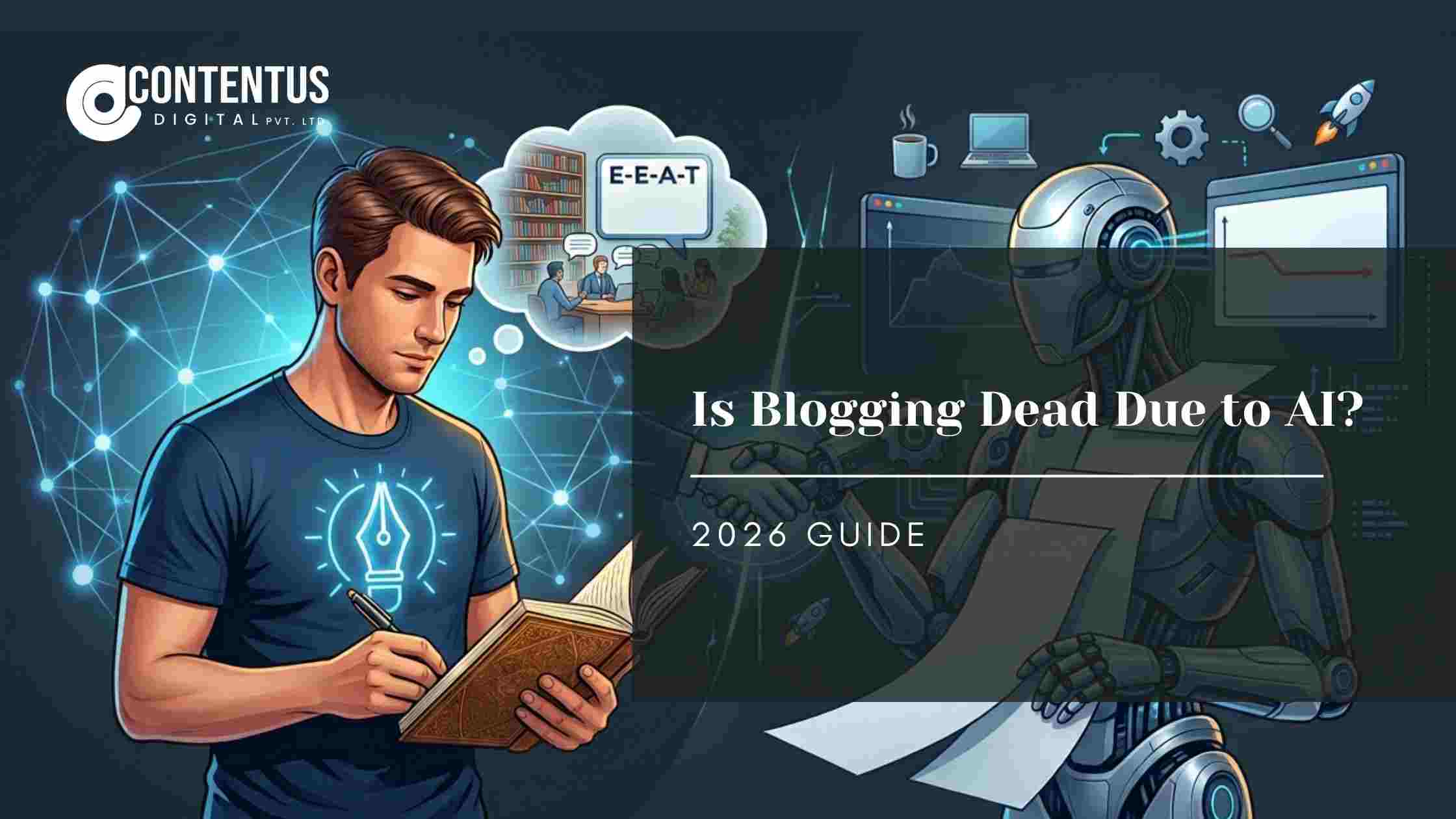
Is Blogging Dead Due to AI?
In this fast-pace, digital dominance world, we are becoming more punctual and always looking for quick solutions. Also, the major technologies have been always there for boosting productivity and act as time savers.
Undoubtedly, AI (Artificial Intelligence) becomes the number one among the list of these technologies. With the explosive rise of generative artificial intelligence, large language models can now churn out thousands of words in mere seconds. This technological shift has sparked a polarizing debate across the marketing world: Is blogging dead due to AI?
Now, critics argue that as AI search engines and chatbots provide instant answers, traditional blogs will become obsolete relics of the early internet. However, this perspective becomes fundamentally wrong. It completely misunderstands why genuine human-written content still add values. As the internet becomes flooded with commoditized, machine-generated text, high-quality human blogs are emerging as premium destinations.
Now, this comprehensive guide will help you to understand is blogging dead due to AI or not.
The Rise of AI Content Inflation
So, what do you think now? Is blogging dead due to AI? You have already predicted the answer. NO. Blogging is not dead. Even, far from being dead, blogging is experiencing a powerful renaissance. There are over 600 million blogs globally, with roughly 7.5 million new blog posts published daily across all platforms.
Now, to understand why blogging is winning, we must look at the problem AI has created: content inflation. What is it? AI can generate an endless stream of SEO-optimized articles at just a single click. Though AI systems can synthesize existing internet data, it lacks the foundational elements of genuine connection: lived experience, authentic authority, and emotional resonance. Thus, the internet is experiencing an unprecedented surge of programmatic, low-effort text. Yet, this has led to a massive paradox of scale: more content, but drastically less value. This way, the AI generated texts causes inflation of the original human generated content.
AI models operate by predicting the next logical word based on historical datasets. As they don’t have any emotional intelligence, they don’t think, feel, never built a business, or traveled to a distant city. As a result, AI-generated content is fundamentally a monotonous content without E-E-A-T. It repeats the average opinion found across the web, resulting in a homogenized sea of sameness.
When every website publishes the exact same AI-synthesized answer, readers grow fatigued. They crave something different, sharp, individualistic, and real.
Why Human Blogs Are Winning Over AI?
Human-led blogs are not just surviving; they are winning over AI because they provide unique dimensions of value that algorithms can’t simulate. A study from Orbit Media shows that only 10% of bloggers publish AI-generated content with minimal editing. Instead, 38% use AI for initial drafting followed by heavy human rewriting. 19% limit AI use strictly to outlines, headlines, and ideation, while creating a blog.
The competitive advantages of human creators can be broken down into four core pillars:
1. The Value of Lived Experience (The E-E-A-T)
Search engines, particularly Google, have adapted their algorithms to combat the influx of AI fluff. They are continuously modifying the algorithms to keep them up-to-date and ensure a strong defence against AI-generated content. By updating their quality guidelines to emphasize E-E-A-T (Experience, Expertise, Authoritativeness, Trustworthiness), they have placed a premium on first-hand experience.
For example, an AI can explain the mechanical steps of repairing a vintage watch, but it can’t share the visceral frustration of losing a rare spring under a workbench or the specific tactile feedback of a perfectly tuned gear.
That’s why humans trust humans who have actually done the work. Hence, creating a blog filled with unique case studies, personal experiments, and authentic trials possess a defensive moat that AI can’t cross.
2. Original Nuance vs. Homogenized Syntheses
AI models excel at summarizing the consensus. If you ask an AI about a controversial industry trend, it will provide a balanced, middle-of-the-road summary. While useful for basic definitions, it is profoundly boring for deep readers. Why? Because at the end of the day, you will understand the answer consists just a generic and average piece of information.
Here, human bloggers bring unique opinions, counter-intuitive insights, and radical perspectives to the table. We, the human bloggers bring true thought leadership that’s built on taking risks and presenting novel ideas. It challenges the status-quo, something an algorithm trained on historical data is structurally incapable of doing. So, when someone asks you: Is blogging dead due to AI, it will be your answer.
Simply, AI can replicate the syntax of knowledge, but it can’t replicate the experience. That is exactly what readers are looking for when they seek out trusted advice.

3. Emotional Resonance and Voice
People don’t read blogs solely for raw data. They read for companionship, entertainment, and shared humanity. A distinct narrative voice; characterized by these elements:
Humor
Vulnerability
Structural idiosyncrasies
Style
These create an emotional bond between the writer and the reader.
In contrast, AI text is notoriously sterile, recognizable by its overly formal tone and predictable transitions. A study found that 52% of readers state they can easily identify purely AI-generated text, which also increases bounce rates if the content lacks human editing. A human blogger can weave a narrative arc that moves a reader to action, makes them laugh, or validates their deepest frustrations.
4. Community Architecture and Micro-Tribes
Blogging has evolved from a one-way publishing medium into a community hub. Modern blogs feature vibrant comment sections, integrated newsletters, live Q&As, and community forums. These are some effective strategies that keep your audience connected longer. Also, readers return to specific blogs because they feel part of a micro-tribe of like-minded individuals.
So, while someone doubt: is blogging dead due to AI or not, tell them that you can’t build a relationship with a chatbot instance. It’s just an ephemeral, transactional utility. A well-researched, human-written blog, however, is a digital home built over years, fostering deep loyalty that transcends algorithmic search shifts.
The Timeless Benefits of Writing a Blog
For brands, entrepreneurs, and individuals, the structural benefits of writing a blog remain unparalleled. Even it remains same in an AI-dominated landscape. Especially, an engaging, long-form blog offers profound strategic advantages:
Compounding Organic Ownership: Social media platforms and algorithmic feeds can change overnight, destroying your visibility. But, a blog is digital real estate that you completely own and control. It acts as a long-term asset that attracts organic traffic over years.
Build Authority That People Trust: Insightful, detailed blog content makes you or your brand the go-to source for your niche. And when you’re constantly solving difficult problems for your audience, you generate institutional trust that makes it easy to sell products or services.
The Ultimate Content Engine: One well-researched, long-form blog post can be the foundation for your entire marketing strategy. It can be turned into a weekly newsletter, converted into 5 LinkedIn posts, scripted into a YouTube video, or clipped into short-form reels.
Another great strategy that helps your business to be established as a thought leader in the industry is building topical authority.
Direct Audience Monetization: Blogs are the primary top of funnel vehicle to capture high-intent email subscribers. Bloggers insulate themselves from platform risk and build direct monetization funnels by changing anonymous web traffic into owned newsletter data.
Paradigm Shift: From Creator to Curator
Declaring the death of blogging confuses a change in form with an extinction event. Instead, you need to understand that blogging is evolving. The time has come to stop writing shallow 500-word articles designed to game search engines. AI has won that particular race. If you can answer a blog post perfectly with one ChatGPT prompt, then there is no reason for that post to be there.
So the successful modern blogger is becoming more of a high level curator and investigator than just a writer. They’re doubling down on investigative journalism, exhaustive data collection, personal experimentation, and hyper-specific niche curation. They use AI as an internal assistant to help them brainstorm outlines, proofread drafts or analyze data.
But they are also making sure that the end product is thoroughly stamped with human ingenuity and unassailable authority.
Conclusion: The Human Premium
Ultimately, AI is not the controller of blogging. Better we can consider it as an ‘Add-on’. When you add it within your regular workflow, it will automate the production of your content.
But if you don’t re-evaluate its output, it will produce some mediocre, generic content. Thus, we can say that AI is forcing the internet to re-evaluate the worth of the written word. This way, it has created a new room for authentic human voices.
As the web becomes increasingly saturated with automated noise, audiences will actively flee toward trusted sanctuaries of human thought. Ultimately, the blogs that lean into real-world experience, cultivate sharp, uncompromising voices, and foster genuine communities will not only win, they will thrive.
So, blogging is not dead. It’s finally paving the way for a purer, more impactful era of human expression.
FAQs
1. Is blogging dead due to AI in 2026?
No, the death of blogging is evolution. AI is good for simple transactional questions, but blogs are still needed for deep expert insight, original first-hand data and unique human perspectives. In fact, AI models and search engines rely on fresh, authoritative blog posts to train, fact-check and cite their answers.
2. How does Google evaluate AI-generated blog posts?
Google doesn’t care if the text is spun, rewritten or whatever you want to call it. Google’s E-E-A-T (Experience, Expertise, Authoritativeness, Trustworthiness) punishes or ignores unedited, mass-produced “AI slop” or generic content. But blogs that combine AI efficiency with human experience, original research and strategic editing perform well.
3. What are the main benefits of writing a blog in the AI era?
The main benefits are owning your digital audience, niche authority and long term organic discovery. Social media posts disappear quickly, while a blog is a long-term business asset that drives direct traffic, collects email leads and feeds authoritative data into AI search overviews.
4. How should creators use AI for blogging without hurting performance?
Think of AI as a collaborator, not an autopilot writer. Hence, the content writing companies in India are using AI for administrative and top of funnel work. These include brainstorming topics, creating outlines, keyword research, and first drafts and let the human writers do the personal stories, unique opinions, fact-checking, and brand voice.
5. Why are human blogs winning over purely AI-generated content?
No algorithm can replicate experience, real-world testing, or emotional connection, so human-written blogs still rule supreme. The internet is more and more clogged with generic AI summaries and readers are actively looking for trusted human creators, with real life case studies, original perspectives and authentic community engagement.